Entree: United States – Baked Macaroni and Cheese with Ham
Food safety reminder: Follow safe food-handling practices and use a food thermometer to verify safe internal cooking temperatures.
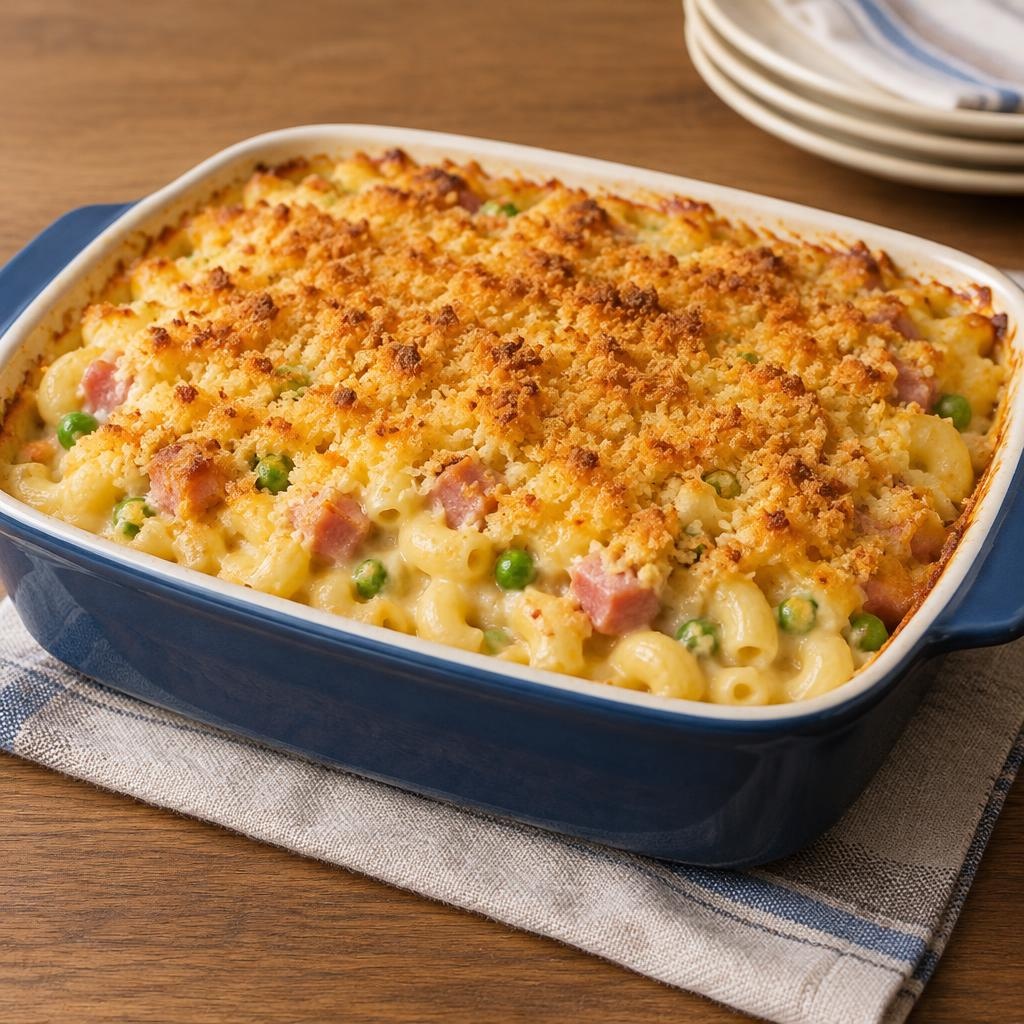
Ingredients
- 6 oz (170 g) macaroni, dry
- 8 oz (227 g) canned ham, diced (usable weight)
- 1 1/4 cups (300 ml) milk
- 3 tbsp (42 g) butter, divided (2 tbsp (30 ml) for sauce, 1 tbsp (15 ml) for topping)
- 2 tbsp (16 g) all-purpose flour
- 1 1/2 cups (170 g) shredded sharp cheddar cheese
- 1/2 cup (75 g) frozen peas, unthawed
- 1/4 cup (25 g) plain breadcrumbs
- 4 cups (960 ml) water for boiling pasta
- salt, to taste
- black pepper, to taste
Instructions
U.S. measurements first, metric equivalents in parentheses. Conversions are approximate.
1. Preheat the oven to 375°F (190°C). Lightly butter a small baking dish about 1 qt (1 L) capacity.
2. Bring a medium pot (2–3 qt (2–3 L)) of 4 cups (960 ml) water to a boil. Add the macaroni and cook uncovered until just al dente per package directions (about 7–9 minutes). Reserve 1/4 cup (60 ml) pasta water, drain pasta, and set aside.
3. In a medium saucepan over medium heat, melt 2 tbsp (28 g) butter. Whisk in 2 tbsp (16 g) all-purpose flour and cook 1–2 minutes until the roux is lightly golden. Slowly whisk in 1 1/4 cups (300 ml) milk and bring to a gentle simmer, stirring frequently, until sauce thickens, about 3–5 minutes.
4. Remove sauce from heat and stir in 1 1/2 cups (170 g) shredded sharp cheddar cheese until smooth. If needed, thin with reserved pasta water, 1 tbsp (15 ml) at a time, to reach a pourable sauce.
5. Stir the drained macaroni, 8 oz (227 g) diced canned ham, and 1/2 cup (75 g) frozen peas into the cheese sauce until evenly combined. Season with salt, to taste, and black pepper, to taste.
6. Transfer the mixture to the prepared 1-qt (1 L) baking dish and smooth the top. In a small bowl combine 1/4 cup (25 g) breadcrumbs with 1 tbsp (14 g) melted butter; sprinkle evenly over the casserole.
7. Bake uncovered in the preheated oven for 18–25 minutes, until the edges are bubbling and the topping is golden brown. For an extra-crisp top, broil on high for 1–2 minutes more, watching closely to avoid burning.
8. Remove from oven and let rest 3–5 minutes before dividing into two portions and serving.
Show original instructions
1. Preheat the oven to 375°F (190°C). Lightly butter a small baking dish about 1 qt (1 L) capacity.
2. Bring a medium pot (2–3 qt/2–3 L) of 4 cups (960 ml) water to a boil. Add the macaroni and cook uncovered until just al dente per package directions (about 7–9 minutes). Reserve 1/4 cup (60 ml) pasta water, drain pasta, and set aside.
3. In a medium saucepan over medium heat, melt 2 tbsp (28 g) butter. Whisk in 2 tbsp (16 g) all-purpose flour and cook 1–2 minutes until the roux is lightly golden. Slowly whisk in 1 1/4 cups (300 ml) milk and bring to a gentle simmer, stirring frequently, until sauce thickens, about 3–5 minutes.
4. Remove sauce from heat and stir in 1 1/2 cups (170 g) shredded sharp cheddar cheese until smooth. If needed, thin with reserved pasta water, 1 tbsp at a time, to reach a pourable sauce.
5. Stir the drained macaroni, 8 oz (227 g) diced canned ham, and 1/2 cup (75 g) frozen peas into the cheese sauce until evenly combined. Season with salt, to taste, and black pepper, to taste.
6. Transfer the mixture to the prepared 1-qt (1 L) baking dish and smooth the top. In a small bowl combine 1/4 cup (25 g) breadcrumbs with 1 tbsp (14 g) melted butter; sprinkle evenly over the casserole.
7. Bake uncovered in the preheated oven for 18–25 minutes, until the edges are bubbling and the topping is golden brown. For an extra-crisp top, broil on high for 1–2 minutes more, watching closely to avoid burning.
8. Remove from oven and let rest 3–5 minutes before dividing into two portions and serving.
Per serving | Servings: 2
Generated: 2026-11-09T17:18:05+00:00
*Values are estimates based on USDA data and mathematical calculations. Actual values may vary. Where data are unavailable, those contributions are excluded. Calories, Carbohydrates, Protein, Fat, Saturated fat, Cholesterol, Sodium, Potassium, Calcium, Iron and Vitamin A are known subtotals. Trans fat is a known subtotal, with data for 5 of 8 ingredients. Fiber, Sugar, Vitamin C and Vitamin D are known subtotals, with data for 7 of 8 ingredients. Missing contributions are unknown, not zero.