Entree: United States – Southern United States – Roasted Pork Tenderloin with Peach Chutney
Food safety reminder: Follow safe food-handling practices and use a food thermometer to verify safe internal cooking temperatures.
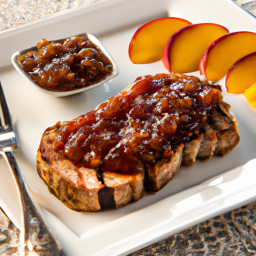
Serving Size: 4
Approximate Time
Prep
20 min
Cook
20 min
Additional
30 min
Total
1 hr 10 min
Ingredients
U.S. measurements first, metric equivalents in parentheses. Conversions are approximate; oz means weight ounces, not fluid ounces.
- 1.75 lb (800 g) pork tenderloin
- 1 tsp (5 g) kosher salt
- 1/2 tsp (1 g) freshly ground black pepper
- 1 tbsp (15 ml) olive oil
- 4 cups (960 ml) (about 28 oz (800 g)) ripe peaches, peeled and diced
- 1 cup (150 g) yellow onion, finely diced
- 1/3 cup (67 g) packed brown sugar
- 1/3 cup (80 ml) apple cider vinegar
- 1/4 cup (40 g) raisins
- 1 tsp (5 g) fresh grated ginger
- 1/2 tsp (1 g) ground cinnamon
- 1 tsp (5 g) mustard seeds
- Salt to taste for chutney
Show original ingredient measurements
- 1.75 lb (800 g) pork tenderloin
- 1 tsp (5 g) kosher salt
- 1/2 tsp (1 g) freshly ground black pepper
- 1 tbsp (15 ml) olive oil
- 4 cups (about 28 oz / 800 g) ripe peaches, peeled and diced
- 1 cup (150 g) yellow onion, finely diced
- 1/3 cup (67 g) packed brown sugar
- 1/3 cup (80 ml) apple cider vinegar
- 1/4 cup (40 g) raisins
- 1 tsp (5 g) fresh grated ginger
- 1/2 tsp (1 g) ground cinnamon
- 1 tsp (5 g) mustard seeds
- Salt to taste for chutney
Instructions
1. Preheat oven to 425°F (220°C). Season pork with kosher salt and black pepper and rub with olive oil.
2. Sear pork in a hot ovenproof skillet 2–3 minutes per side until browned. Transfer skillet to oven and roast until internal temperature reaches 145°F (63°C), about 12–18 minutes depending on size.
3. While pork roasts, combine peaches, onion, brown sugar, apple cider vinegar, raisins, grated ginger, cinnamon, and mustard seeds in a saucepan.
4. Bring chutney mixture to a simmer over medium heat, then reduce heat to low and cook, stirring occasionally, until thickened and slightly jammy, about 25–30 minutes. Season with salt to taste.
5. Remove pork from oven and rest 5–10 minutes under foil. Slice pork and spoon warm peach chutney over each serving.
Estimated Nutritional Information*
Per serving | Servings: 4
Calories: 391 kcal
Carbohydrates: 29 g
Protein: 42.4 g
Fat: 11 g
Saturated fat: 2.9 g
Cholesterol: 130 mg
Fiber: 1.5 g
Sugar: 24.6 g
Sodium: 599 mg
Potassium: 971 mg
Calcium: 50 mg
Iron: 2.55 mg
Vitamin A: 0 µg RAE
Vitamin C: 3.2 mg
Vitamin D: 0.6 µg
Nutrition estimated: November 5, 2026
*Values are estimates based on USDA data and mathematical calculations. Actual values may vary. Where data are unavailable, those contributions are excluded. Calories, Carbohydrates, Protein, Fat, Saturated fat, Cholesterol, Fiber, Sugar, Sodium, Potassium, Calcium, Iron, Vitamin A, Vitamin C and Vitamin D are known subtotals. Missing contributions are unknown, not zero.