Salad: Italy – Insalata di Pomodoro e Cipolla (Tomato and Red Onion Salad (Oregano))
Food safety reminder: Follow safe food-handling practices and use a food thermometer to verify safe internal cooking temperatures.
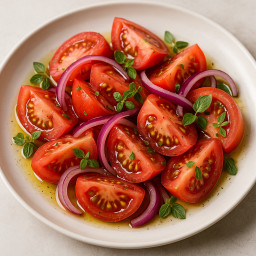
Serving Size: 4
Approximate Time
Prep
10 min
Cook
0 min
Additional
15 min
Total
25 min
Ingredients
U.S. measurements first, metric equivalents in parentheses. Conversions are approximate; oz means weight ounces, not fluid ounces.
- 1 lb (450 g) ripe tomatoes, cut into wedges or 1/2-inch (1.27 cm) slices
- 1 small red onion (about 4 oz (115 g)), thinly sliced
- 3 tbsp (45 ml) extra-virgin olive oil
- 1 tbsp (15 ml) red wine vinegar
- 1 tbsp (3 g) fresh oregano leaves, chopped (or 1 tsp (1 g) dried oregano)
- 1/2 tsp (2.5 g) kosher salt, plus more to taste
- 1/4 tsp (0.5 g) freshly ground black pepper, plus more to taste
- 1 tsp (4 g) granulated sugar (optional, to balance acidity)
- 1 tbsp (15 g) fresh basil leaves, torn (optional)
Show original ingredient measurements
- 1 lb (450 g) ripe tomatoes, cut into wedges or 1/2-inch slices
- 1 small red onion (about 4 oz/115 g), thinly sliced
- 3 tbsp (45 ml) extra-virgin olive oil
- 1 tbsp (15 ml) red wine vinegar
- 1 tbsp (3 g) fresh oregano leaves, chopped (or 1 tsp/1 g dried oregano)
- 1/2 tsp (2.5 g) kosher salt, plus more to taste
- 1/4 tsp (0.5 g) freshly ground black pepper, plus more to taste
- 1 tsp (4 g) granulated sugar (optional, to balance acidity)
- 1 tbsp (15 g) fresh basil leaves, torn (optional)
Instructions
1. Place the tomato wedges or slices in a large bowl. Add the thinly sliced red onion.
2. In a small bowl or jar whisk together the olive oil, red wine vinegar, oregano, salt, pepper, and sugar (if using) until combined.
3. Pour the dressing over the tomatoes and onions and toss gently to coat, taking care not to break the tomato pieces.
4. Let the salad rest at room temperature for 10–15 minutes to allow flavors to meld; taste and adjust salt, pepper, or vinegar as needed.
5. Just before serving, sprinkle torn basil over the salad if using and give a final gentle toss. Serve at room temperature.
Estimated Nutritional Information*
Per serving | Servings: 4
Calories: 128 kcal
Carbohydrates: 8.4 g
Protein: 1.5 g
Fat: 10.4 g
Saturated fat: 1.4 g
Fiber: 2 g
Sugar: 5.2 g
Sodium: 250 mg
Potassium: 326 mg
Calcium: 30 mg
Iron: 0.66 mg
Vitamin A: 57 µg RAE
Vitamin C: 18.2 mg
Nutrition estimated: November 5, 2026
*Values are estimates based on USDA data and mathematical calculations. Actual values may vary. Where data are unavailable, those contributions are excluded. Sodium is a known subtotal. Missing contributions are unknown, not zero.