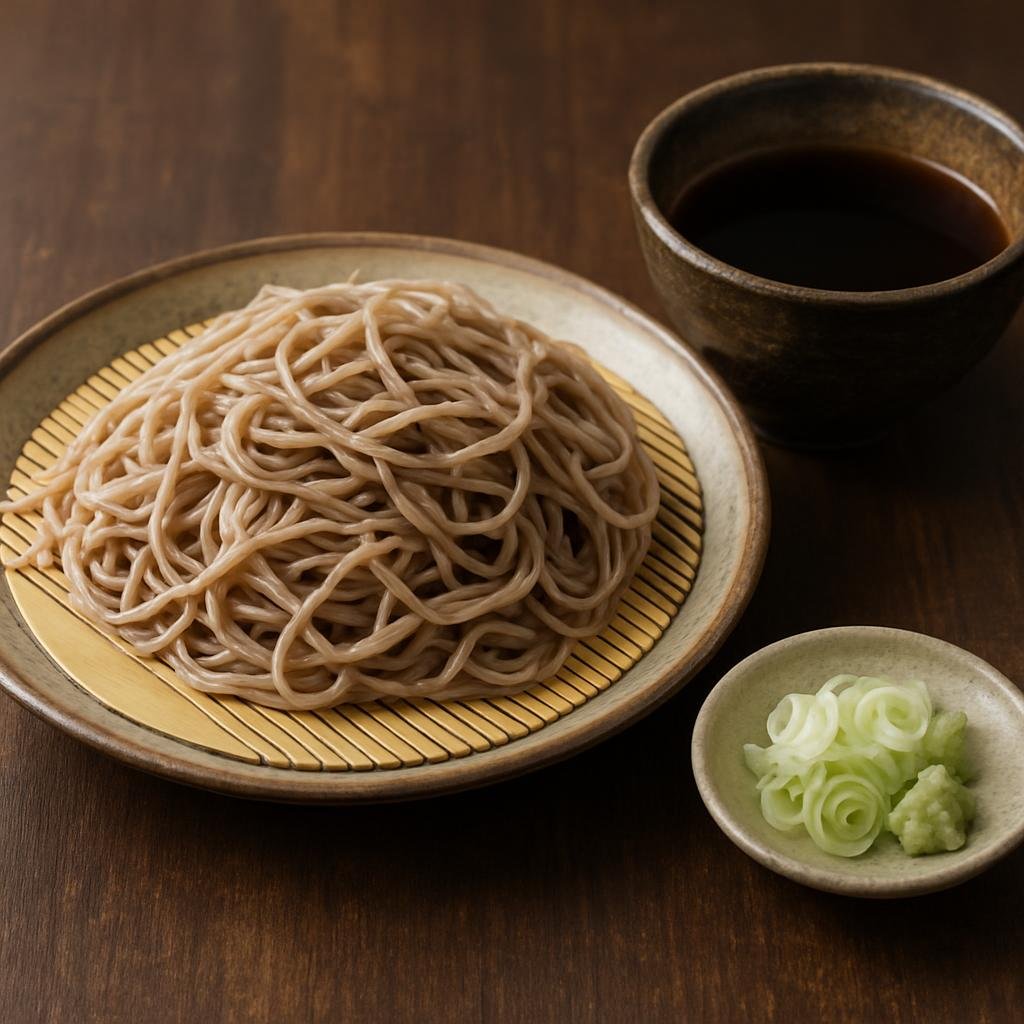
Entree: Japan – Chubu – 信州そば ➤ Shinshū Soba (Buckwheat noodles from Shinshu served with chilled dipping sauce)
Food safety reminder: Follow safe food-handling practices and use a food thermometer to verify safe internal cooking temperatures.
Serving Size: 4
Approximate Time
Prep
20 min
Cook
6 min
Additional
5 min
Total
30 min
Ingredients
U.S. measurements first, metric equivalents in parentheses. Conversions are approximate; oz means weight ounces, not fluid ounces.
- 12 oz (340 g) soba noodles (100% or high-buckwheat content), dried or fresh
- 4 cups (960 ml) dashi stock (made from kombu and katsuobushi or instant dashi)
- 1/3 cup (80 ml) soy sauce
- 1/4 cup (60 ml) mirin
- 1 tbsp (15 ml) sake (optional)
- 1 tbsp (15 g) granulated sugar
- 2 scallions, thinly sliced
- 1 sheet nori, shredded (about 0.071 oz (2 g))
- 1 tsp (5 g) wasabi paste, or to taste
- 1/2 cup (50 g) grated daikon radish (optional)
- Ice and cold water for chilling noodles
Show original ingredient measurements
- 12 oz (340 g) soba noodles (100% or high-buckwheat content), dried or fresh
- 4 cups (960 ml) dashi stock (made from kombu and katsuobushi or instant dashi)
- 1/3 cup (80 ml) soy sauce
- 1/4 cup (60 ml) mirin
- 1 tbsp (15 ml) sake (optional)
- 1 tbsp (15 g) granulated sugar
- 2 scallions, thinly sliced
- 1 sheet nori, shredded (about 2 g)
- 1 tsp (5 g) wasabi paste, or to taste
- 1/2 cup (50 g) grated daikon radish (optional)
- Ice and cold water for chilling noodles
Instructions
U.S. measurements first, metric equivalents in parentheses. Conversions are approximate.
1. If making dashi: wipe 6x6 inch (15x15 cm) kombu and steep in 4 cups (960 ml) cold water for 30 minutes, heat until just before boiling, remove kombu, add a generous handful (about 0.35 oz (10 g)) katsuobushi, simmer 1 minute, turn off heat, steep 5 minutes, then strain to yield dashi. Alternatively, dissolve instant dashi to total 4 cups (960 ml).
2. In a small saucepan combine 1 cup (240 ml) of the dashi with soy sauce, mirin, sake (if using) and sugar; bring to a gentle simmer to dissolve sugar, then remove from heat and let cool. For a concentrated tsuyu, this mixture is the dipping sauce; refrigerate until cold.
3. Bring a large pot of water to a rolling boil. Add soba noodles and cook according to package instructions until just tender, usually 4–5 minutes for dried soba.
4. Immediately drain noodles and rinse under cold running water while tossing to remove surface starch. Transfer to a bowl of ice water to chill thoroughly, then drain well.
5. Divide chilled noodles among 4 serving plates or zaru (bamboo trays). Pour tsuyu into 4 small individual dipping bowls; if desired, dilute tsuyu with remaining chilled dashi to taste.
6. Serve with sliced scallions, shredded nori, grated daikon and a small amount of wasabi on the side. Dip cold noodles into tsuyu and eat immediately.
Show original instructions
1. If making dashi: wipe 6x6 inch (15x15 cm) kombu and steep in 4 cups (960 ml) cold water for 30 minutes, heat until just before boiling, remove kombu, add a generous handful (about 10 g) katsuobushi, simmer 1 minute, turn off heat, steep 5 minutes, then strain to yield dashi. Alternatively, dissolve instant dashi to total 4 cups (960 ml).
2. In a small saucepan combine 1 cup (240 ml) of the dashi with soy sauce, mirin, sake (if using) and sugar; bring to a gentle simmer to dissolve sugar, then remove from heat and let cool. For a concentrated tsuyu, this mixture is the dipping sauce; refrigerate until cold.
3. Bring a large pot of water to a rolling boil. Add soba noodles and cook according to package instructions until just tender, usually 4–5 minutes for dried soba.
4. Immediately drain noodles and rinse under cold running water while tossing to remove surface starch. Transfer to a bowl of ice water to chill thoroughly, then drain well.
5. Divide chilled noodles among 4 serving plates or zaru (bamboo trays). Pour tsuyu into 4 small individual dipping bowls; if desired, dilute tsuyu with remaining chilled dashi to taste.
6. Serve with sliced scallions, shredded nori, grated daikon and a small amount of wasabi on the side. Dip cold noodles into tsuyu and eat immediately.
Estimated Nutritional Information*
Per serving | Servings: 4
Calories: 394 kcal
Carbohydrates: 81.3 g
Protein: 12.6 g
Fat: 2.7 g
Sodium: 1304 mg
Generated: 2026-11-05T19:42:38+00:00
*Values are estimates based on USDA data and mathematical calculations. Actual values may vary. Where data are unavailable, those contributions are excluded. Calories, Carbohydrates, Protein, Fat and Sodium are known subtotals. Missing contributions are unknown, not zero.