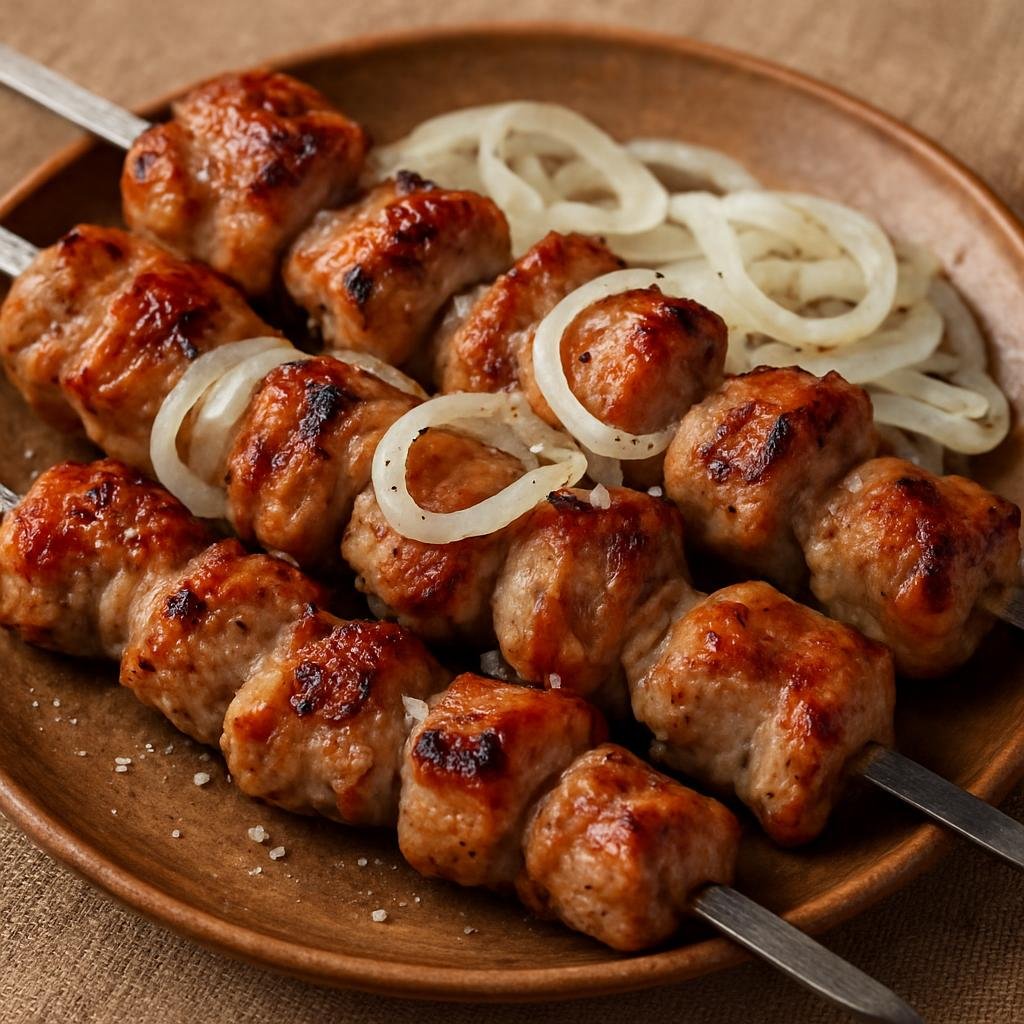
Entree: Georgia – Tbilisi & Eastern Georgia – მწვადი ➤ mts'vadi (Charcoal-grilled skewered meat, traditionally pork or lamb, seasoned simply with onions and salt)
Food safety reminder: Follow safe food-handling practices and use a food thermometer to verify safe internal cooking temperatures.
Serving Size: 4
Approximate Time
Prep
10 min
Cook
18 min
Additional
2 hrs
Total
2 hrs 30 min
Ingredients
U.S. measurements first, metric equivalents in parentheses. Conversions are approximate; oz means weight ounces, not fluid ounces.
- 2 lb (900 g) pork shoulder, cut into 1½–2 in (3–5 cm) cubes
- 1 large (8 oz (225 g)) onion, thinly sliced
- 1 tbsp (18 g) coarse salt
- 1 tsp (5 g) ground black pepper
- 2 tbsp (30 ml) vegetable oil
- 2 tbsp (30 ml) white wine vinegar or pomegranate juice
- 1 bay leaf (optional)
- Metal or wooden skewers (if using wooden, soak 30 minutes)
- Extra coarse salt for finishing
Show original ingredient measurements
- 2 lb (900 g) pork shoulder, cut into 1½–2 in (3–5 cm) cubes
- 1 large (8 oz / 225 g) onion, thinly sliced
- 1 tbsp (18 g) coarse salt
- 1 tsp (5 g) ground black pepper
- 2 tbsp (30 ml) vegetable oil
- 2 tbsp (30 ml) white wine vinegar or pomegranate juice
- 1 bay leaf (optional)
- Metal or wooden skewers (if using wooden, soak 30 minutes)
- Extra coarse salt for finishing
Instructions
1. In a large bowl combine the pork cubes, sliced onion, coarse salt, ground black pepper, vegetable oil, and vinegar or pomegranate juice. Mix thoroughly so onion and seasonings coat the meat; cover and refrigerate for at least 2 hours or up to overnight.
2. If using wooden skewers, soak them in water 30 minutes before grilling. Thread the marinated meat onto skewers, leaving a little space between pieces for even cooking.
3. Prepare a hot charcoal grill or wood fire so coals are evenly hot; traditional mtsvadi is cooked over open coals. Place skewers over medium-high heat and grill, turning occasionally, until well browned and cooked through, about 12–18 minutes depending on cube size.
4. During the last few minutes, baste with a little extra oil and sprinkle a pinch of extra coarse salt to finish. Remove from grill and let rest 5 minutes before serving. Serve with raw onion slices and lavash or crusty bread.
Estimated Nutritional Information*
Per serving | Servings: 4
Calories: 618 kcal
Carbohydrates: 6.1 g
Protein: 39.4 g
Fat: 47.4 g
Saturated fat: 15.1 g
Fiber: 1.3 g
Sodium: 1893 mg
Potassium: 782 mg
Calcium: 54 mg
Iron: 2.68 mg
Vitamin A: 5 µg RAE
Vitamin C: 5.8 mg
Nutrition estimated: November 5, 2026
*Values are estimates based on USDA data and mathematical calculations. Actual values may vary. Where data are unavailable, those contributions are excluded. Calories, Carbohydrates, Protein, Fat, Saturated fat, Fiber, Sodium, Potassium, Calcium, Iron, Vitamin A and Vitamin C are known subtotals. Missing contributions are unknown, not zero.