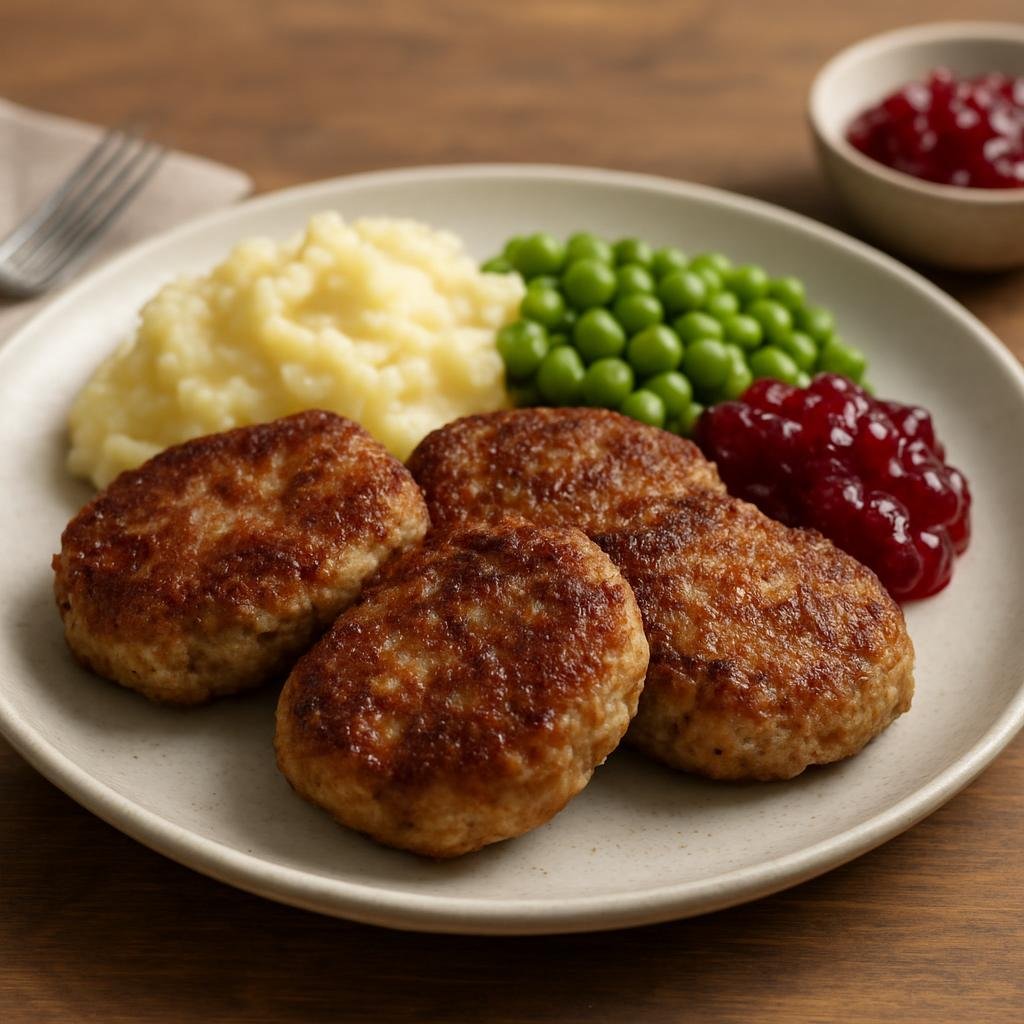
Entree: Denmark – Jutland – Krebinetter (Pan-fried Danish seasoned pork patties, lightly breaded and cooked until golden)
Food safety reminder: Follow safe food-handling practices and use a food thermometer to verify safe internal cooking temperatures.
Ingredients
U.S. measurements first, metric equivalents in parentheses. Conversions are approximate; oz means weight ounces, not fluid ounces.
- 1 lb (454 g) ground pork
- 2 slices (approx. 2 1/8 oz (60 g)) day-old white bread, crusts removed and torn
- 1/2 cup (120 ml) milk
- 1 large egg (approx. 1 3/4 oz (50 g))
- 1 small onion, finely chopped (approx. 2 1/2 oz (70 g))
- 1 tsp (6 g) salt
- 1/2 tsp (1 g) ground white pepper
- 1/4 tsp (0.5 g) ground nutmeg
- 1/2 cup (60 g) all-purpose flour, for dredging
- 3 tbsp (45 ml) butter
- 1 tbsp (15 ml) neutral oil (such as canola) for frying
- 1 cup (240 ml) beef or veal stock (for gravy)
- 1 tbsp (8 g) all-purpose flour (for gravy)
- 1 lb (454 g) baby or new potatoes, scrubbed (to serve)
- Salt and black pepper to taste
- Optional: pickled red cabbage to serve
Show original ingredient measurements
- 1 lb (454 g) ground pork
- 2 slices (approx. 60 g) day-old white bread, crusts removed and torn
- 1/2 cup (120 ml) milk
- 1 large egg (approx. 50 g)
- 1 small onion, finely chopped (approx. 70 g)
- 1 tsp (6 g) salt
- 1/2 tsp (1 g) ground white pepper
- 1/4 tsp (0.5 g) ground nutmeg
- 1/2 cup (60 g) all-purpose flour, for dredging
- 3 tbsp (45 ml) butter
- 1 tbsp (15 ml) neutral oil (such as canola) for frying
- 1 cup (240 ml) beef or veal stock (for gravy)
- 1 tbsp (8 g) all-purpose flour (for gravy)
- 1 lb (454 g) baby or new potatoes, scrubbed (to serve)
- Salt and black pepper to taste
- Optional: pickled red cabbage to serve
Instructions
U.S. measurements first, metric equivalents in parentheses. Conversions are approximate.
1. Place torn bread in a small bowl and pour milk over it; let soak until soft, then squeeze out excess liquid and mash.
2. In a bowl combine ground pork, soaked bread, chopped onion, egg, salt, pepper, and nutmeg; mix gently until just combined—do not overwork.
3. With wet hands, shape mixture into 8 oval patties (about 2.5–3 oz (70–85 g) each). Dredge each patty lightly in 1/2 cup (60 g) flour, shaking off excess.
4. Heat butter and oil in a large skillet over medium heat until foaming. Fry patties in batches 3–4 minutes per side, or until golden brown and cooked through (internal temperature 160°F / 71°C). Transfer to a warm plate and keep covered.
5. For gravy, pour off excess oil leaving about 1 tbsp (15 ml) in the pan. Sprinkle 1 tbsp (8 g) flour into pan and cook, stirring, 1 minute. Whisk in 1 cup (240 ml) stock and simmer until thickened; season with salt and pepper.
6. Meanwhile, boil potatoes in salted water until tender, about 12–15 minutes; drain.
7. Serve krebinetter hot with boiled potatoes, brown gravy, and pickled red cabbage if desired.
Show original instructions
1. Place torn bread in a small bowl and pour milk over it; let soak until soft, then squeeze out excess liquid and mash.
2. In a bowl combine ground pork, soaked bread, chopped onion, egg, salt, pepper, and nutmeg; mix gently until just combined—do not overwork.
3. With wet hands, shape mixture into 8 oval patties (about 2.5–3 oz / 70–85 g each). Dredge each patty lightly in 1/2 cup (60 g) flour, shaking off excess.
4. Heat butter and oil in a large skillet over medium heat until foaming. Fry patties in batches 3–4 minutes per side, or until golden brown and cooked through (internal temperature 160°F / 71°C). Transfer to a warm plate and keep covered.
5. For gravy, pour off excess oil leaving about 1 tbsp (15 ml) in the pan. Sprinkle 1 tbsp (8 g) flour into pan and cook, stirring, 1 minute. Whisk in 1 cup (240 ml) stock and simmer until thickened; season with salt and pepper.
6. Meanwhile, boil potatoes in salted water until tender, about 12–15 minutes; drain.
7. Serve krebinetter hot with boiled potatoes, brown gravy, and pickled red cabbage if desired.
Per serving | Servings: 4
Nutrition estimated: November 5, 2026
*Values are estimates based on USDA data and mathematical calculations. Actual values may vary. Where data are unavailable, those contributions are excluded. Calories, Carbohydrates, Protein, Fat, Saturated fat, Cholesterol, Fiber, Sodium, Potassium, Calcium, Iron, Vitamin A and Vitamin C are known subtotals. Missing contributions are unknown, not zero.